tender (adj.)

“soft, easily injured,” early 13c., from Old French tendre “soft, delicate; young” (11c.), from Latin tenerem (nominative tener) “soft, delicate; of tender age, youthful,” from a derivative of PIE root *ten- “to stretch,” on the notion of “stretched,” hence “thin,” hence “weak” or “young.” Compare Sanskrit tarunah “young, tender,” Greek teren “tender, delicate,” Armenian t’arm “young, fresh, green.”

Meaning “kind, affectionate, loving” first recorded early 14c. Meaning “having the delicacy of youth, immature” is attested in English from early 14c. Related: TenderlytendernessTender-hearted first recorded 1530s.

friend (v.)

in the Facebook sense, attested from 2005, from the noun. Friend occasionally has been used as a verb in English since c. 1200 (“to be friends”), though the more usual verb for “join in friendship, act as a friend” is befriend. Related: Friendedfriending. Old English had freonsped “an abundance of friends” (see speed (n.)); freondleast “want of friends;” freondspedig “rich in friends.”

friend (n.)

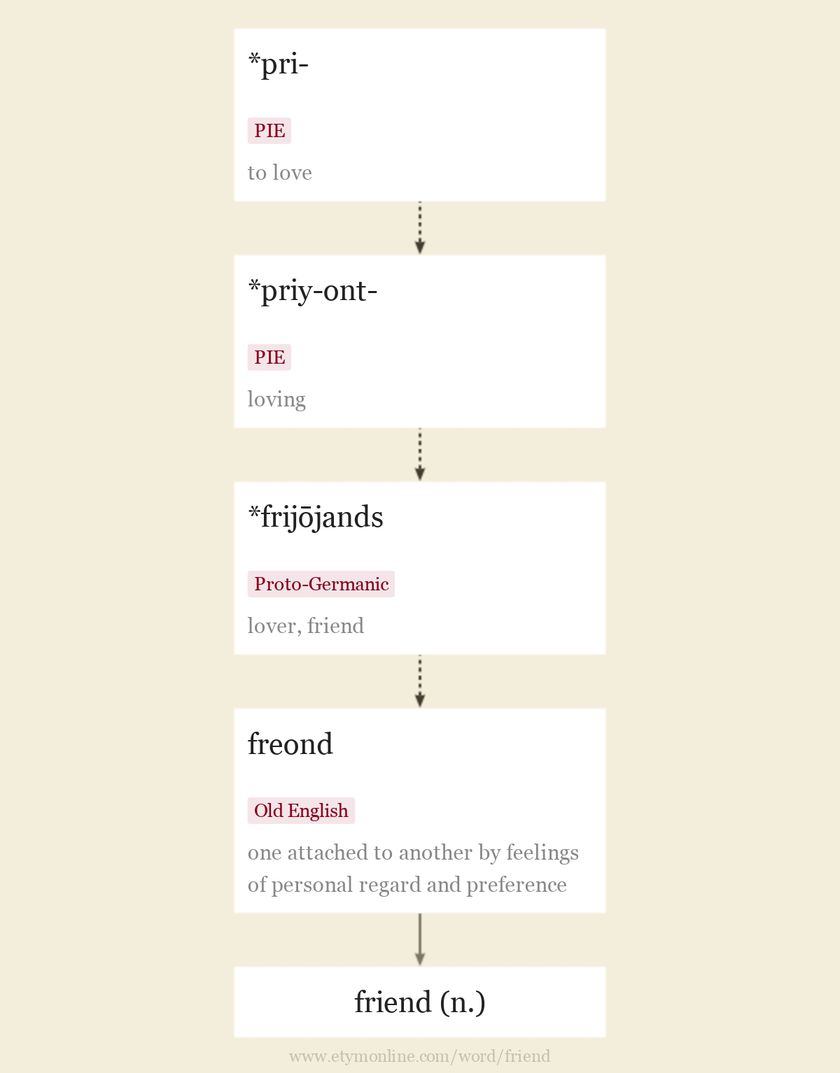
Old English freond “one attached to another by feelings of personal regard and preference,” from Proto-Germanic *frijōjands “lover, friend” (source also of Old Norse frændi, Old Danish frynt, Old Frisian friund, Dutch vriend, Middle High German friunt, German Freund, Gothic frijonds “friend”), from PIE *priy-ont-, “loving,” present-participle form of root *pri- “to love.”

Meaning “a Quaker” (a member of the Society of Friends) is from 1670s. Feond (“fiend,” originally “enemy”) and freond often were paired alliteratively in Old English; both are masculine agent nouns derived from present participle of verbs, but they are not directly related to one another (see fiend). Related: Friends.

Origin and meaning of friend

charge (n.)

c. 1200, “a load, a weight,” from Old French charge “load, burden; imposition,” from chargier “to load, to burden,” from Late Latin carricare “to load a wagon or cart,” from Latin carrus “two-wheeled wagon” (see car). A doublet of cargo.

Meaning “responsibility, burden” is from mid-14c. (as in take charge, late 14c.; in charge, 1510s), which progressed to “pecuniary burden, cost, burden of expense” (mid-15c.), and then to “price demanded for service or goods” (1510s). Meaning “anything committed to another’s custody, care, or management” is from 1520s.

Legal sense of “accusation” is late 15c.; earlier “injunction, order” (late 14c.). Meaning “address delivered by a judge to a jury at the close of a trial” is from 1680s. Electrical sense is from 1767. Slang meaning “thrill, kick” (American English) is from 1951. Meaning “quantity of powder required for one discharge of a firearm” is from 1650s. Military meaning “impetuous attack upon an enemy” is from 1560s; as an order or signal to make such an attack, 1640s.

charge (v.)

early 13c., “to load, put a burden on or in; fill with something to be retained,” from Old French chargier “to load, burden, weigh down,” from Late Latin carricare “to load a wagon or cart,” from Latin carrus “two-wheeled wagon” (see car).

Senses of “entrust,” “command,” and “accuse” all emerged in Middle English and were found in Old French. Sense of “rush in to attack, bear down upon” is from 1560s, perhaps through earlier meaning “load a weapon” (1540s). Meaning “impose a burden of expense” is from mid-14c. That of “to fix or ask as a price” is from 1787; meaning “hold liable for payment, enter a debt against” is by 1889. Meaning “fill with electricity” is from 1748. Related: Chargedcharging.

demand (n.)

late 13c., demaunde, “a question,” from Old French demande, from demander “to request; to demand” (see demand (v.)). Meaning “a request, a claim, an asking for by virtue of a right or supposed right to the thing sought,” also “that which is demanded or required, exaction as a tribute or concession,” without reference to right, is from c. 1300.

In the political economy sense of “desire to purchase and possess, coupled with the means to do so” (correlating to supply) it is attested from 1776 in Adam Smith. Meaning “state of being sought after” (especially by consumers) is from 1711. In demand “much sought after” is attested by 1825; on demand “on being requested” is from 1690s.

demand (v.)

late 14c., demaunden, “ask questions, make inquiry,” from Old French demander (12c.) “to request; to demand,” from Latin demandare “entrust, charge with a commission” (in Medieval Latin, “to ask, request, demand”), from de- “completely” (see de-) + mandare “to order” (see mandate (n.)).

Meaning “ask for with insistence or urgency” is from early 15c., from Anglo-French legal use (“to ask for as a right”). Meaning “require as necessary or useful” is by 1748. Related: Demandeddemanding.

require (v.)

late 14c., “to ask a question, inquire,” from Old French requerre “seek, procure; beg, ask, petition; demand,” from Vulgar Latin *requaerere, from Latin requirere “seek to know, ask,” from re-, here perhaps meaning “repeatedly” (see re-), + quaerere “ask, seek” (see query (v.)).

The original sense of this word has been taken over by request (v.). Sense of “demand (someone) to do (something)” is from 1751, via the notion of “to ask for imperatively, or as a right” (late 14c.). Related: Requiredrequiring.

cancel (v.)

late 14c., “cross out with lines, draw lines across (something written) so as to deface,” from Anglo-French and Old French canceler, from Latin cancellare “to make like a lattice,” which in Late Latin took on especially a sense “cross out something written” by marking it with crossed lines, from cancelli, plural of *cancellus (n.) “lattice, grating,” diminutive of cancer “crossed bars, a lattice,” a variant of carcer “prison” (see incarceration).

Figurative use, “to nullify (an obligation, etc.)” is from mid-15c. Related: Canceled (also cancelled); cancelling.