“authority to command the national military forces,” in extended use “an empire,” 1650s, from Latin imperium “command, supreme authority, power” (see empire). Hence Latin phrase imperium in imperio “a state within a state.”
Category: Uncategorized
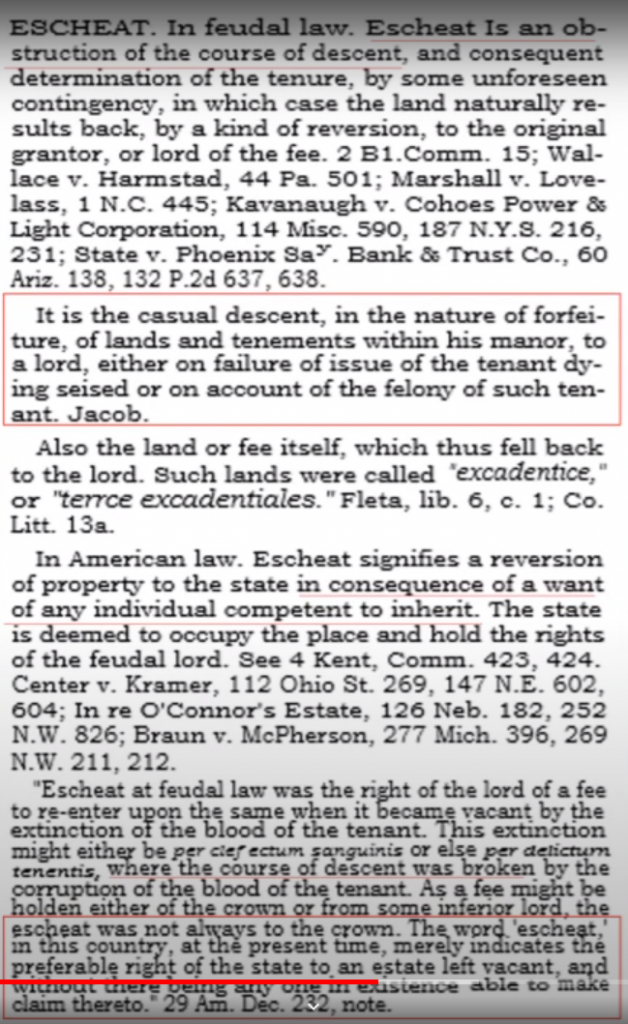
Legal Definition: Escheat
intrinsic (adj.)
late 15c., “interior, inward, internal,” from Old French intrinsèque “inner” (14c.), from Medieval Latin intrinsecus “interior, internal,” from Latin intrinsecus (adv.) “inwardly, on the inside,” from intra “within” (see intra-) + secus “along, alongside,” from PIE *sekw-os- “following,” suffixed form of root *sekw- (1) “to follow.”
PEEPLES v. CITY OF DETROIT 344
H.R.5404 – To define the dollar as a fixed weight of gold.
Legal Consideration = Something of value
Corpus delicti = injured party
Corpus delicti (Latin: ‘body of the crime‘; plural: corpora delicti) is a term from Western jurisprudence referring to the principle that a crime must be proved to have occurred before a person can be convicted of committing that crime.
For example, a person cannot be tried for larceny unless it can be proven that property has been stolen.
acquiesce (v.)
1610s, “remain at rest” (a sense now obsolete); 1650s as “agree tacitly, concur,” from French acquiescer “to yield or agree to; be at rest,” (14c.), from Latin acquiescere/adquiescere “become quiet, remain at rest, rest, repose,” thus “be satisfied with, be content,” from ad “to” (see ad-) + quiescere “become quiet,” from quies (genitive quietis) “rest, quiet” (from PIE root *kweie- “to rest, be quiet”). Related: Acquiesced; acquiescing.
acquiescence (n.)
1630s, “rest, quiet, satisfaction,” from French acquiescence, noun of action from acquiescer “to yield or agree to; be at rest” (see acquiesce). Meaning “silent consent, passive assent” is recorded from 1640s.
annex (v.)
late 14c., “to connect with,” from Old French annexer “to join, attach” (13c.), from Medieval Latin annexare, frequentative of Latin annecetere “to bind to,” from ad “to” (see ad-) + nectere “to tie, bind” (from PIE root *ned- “to bind, tie”). Usually meaning “to join in a subordinate capacity,” but that notion is not in the etymology. Of nations or territories, c. 1400. Related: Annexed; annexing.
annex (n.)
1540s, “an adjunct, accessory,” from French annexe “that which is joined” (13c.), from annexer “to join” (see annex (v.)). Meaning “supplementary building” is from 1861
erudite (adj.)
early 15c., “learned, well-instructed,” from Latin eruditus “learned, accomplished, well-informed,” past participle of erudire “to educate, teach, instruct, polish,” literally “to bring out of the rough,” from assimilated form of ex “out” (see ex-) + rudis “unskilled, rough, unlearned” (see rude). Related: Eruditely.