c. 1300, “slab or flat surface for an inscription” (especially the two Mosaic tables of stone), from Old French tablete “small table, merchant’s display counter” (13c., Modern French tablette), diminutive of table “slab,” or from Medieval Latin tabuleta (source also of Spanish tableta, Italian tavoletta), diminutive of Latin tabula (see table (n.)). The meaning “lozenge, pill” is first recorded 1580s; that of “pad of writing paper” in 1880.
Category: Uncategorized
Statute of Westminster 1931
The Statute of Westminster 1931 is an Act of the Parliament of the United Kingdom whose modified versions are now domestic law within Australia and Canada; it has been repealed in New Zealand and implicitly in former Dominions that are no longer Commonwealth realms. Passed on 11 December 1931, the act,[2] either immediately or upon ratification, effectively both established the legislative independence of the self-governing Dominions of the British Empire from the United Kingdom and bound them all to seek each other’s approval for changes to monarchical titles and the common line of succession. It thus became a statutory embodiment of the principles of equality and common allegiance to the Crown set out in the Balfour Declaration of 1926. As the statute removed nearly all of the British parliament’s authority to legislate for the Dominions, it had the effect of making the Dominions largely sovereign nations in their own right. It was a crucial step in the development of the Dominions as separate states.
sublime (adj.)
1580s, “expressing lofty ideas in an elevated manner,” from Middle French sublime (15c.), or directly from Latin sublimis “uplifted, high, borne aloft, lofty, exalted, eminent, distinguished,” possibly originally “sloping up to the lintel,” from sub “up to” (see sub-) + limen “lintel, threshold, sill” (see limit (n.)). The sublime (n.) “the sublime part of anything, that which is stately or imposing” is from 1670s. For Sublime Porte, former title of the Ottoman government, see Porte.
S. 1200 (110th): Indian Health Care Improvement Act Amendments of 2008
2/26/2008–Passed Senate amended. Indian Health Care Improvement Act Amendments of 2008 – Reauthorizes Indian Health Service (IHS) programs.
Title I: Amendments to Indian Laws – (Sec. 101) Amends the Indian Health Care Improvement Act ( IHCIA) to declare a national Indian health policy to: (1) raise the health status of Indians and Urban Indians by 2010 to at least the levels set forth in the goals contained within the Healthy People 2010 or successor objectives; (2) ensure maximum Indian participation in the direction of health care services to make the persons administering such services and the services themselves more responsive to the needs and desires of Indian communities; and (3) ensure that the United States and Indian Tribes work together to ensure quality health care for all tribal members.
principality (n.)
c. 1300, “position of a prince,” from Old French principalite “principal matter; power, sovereignty” (12c., Modern French principauté), from Late Latin principalitatem (nominative principalitas), from principalis (see principal (adj.)). Meaning “region or state ruled by a prince” is attested from c. 1400.
Review
Security and Prosperity Partnership of North America
The Security and Prosperity Partnership of North America (SPP) was a region-level dialogue with the stated purpose of providing greater cooperation on security and economic issues.[1] The Partnership was founded in Waco, Texas, on March 23, 2005, by Prime Minister of Canada Paul Martin, President of Mexico Vicente Fox, and U.S. President George W. Bush.[1] It was the second of such regional-level agreements involving the United States following the 1997 Partnership for Prosperity and Security in the Caribbean (PPS).
Since August 2009 it is no longer an active initiative of any of the original dialogue partners. It has been largely superseded by the annual North American Leaders’ Summit, an event that was established as part of SPP.
https://en.wikipedia.org/wiki/Security_and_Prosperity_Partnership_of_North_America
Dimensions of Radionics by David V. Tansley (1977-06-30) Hardcover – 1641

Queen Elizabeth related to Charlotte of Mecklenburg-Strelitz related to Queen Victoria
Charlotte of Mecklenburg-Strelitz (Sophia Charlotte; 19 May 1744 – 17 November 1818) was the wife of King George III. She was Queen of Great Britain and Ireland from her wedding in 1761 until the union of the two kingdoms in 1801, after which she was queen consort of the United Kingdom of Great Britain and Ireland until her death in 1818. She was also the Electress consort of Hanover in the Holy Roman Empire until the promotion of her husband to King of Hanover on 12 October 1814, after which she was also queen consort of Hanover.
Charlotte was a patron of the arts and an amateur botanist who helped expand Kew Gardens. She was distressed by her husband’s bouts of physical and mental illness, which became permanent in later life and resulted in their eldest son George’s appointment as Prince Regent in 1811. George III and Charlotte had 15 children in total, 13 of whom survived to adulthood. They included two future British monarchs, George IV and William IV; Charlotte, Queen of Württemberg; Prince Edward, Duke of Kent and Strathearn, the father of Queen Victoria; and Ernest Augustus, King of Hanover.

https://en.wikipedia.org/wiki/Charlotte_of_Mecklenburg-Strelitz
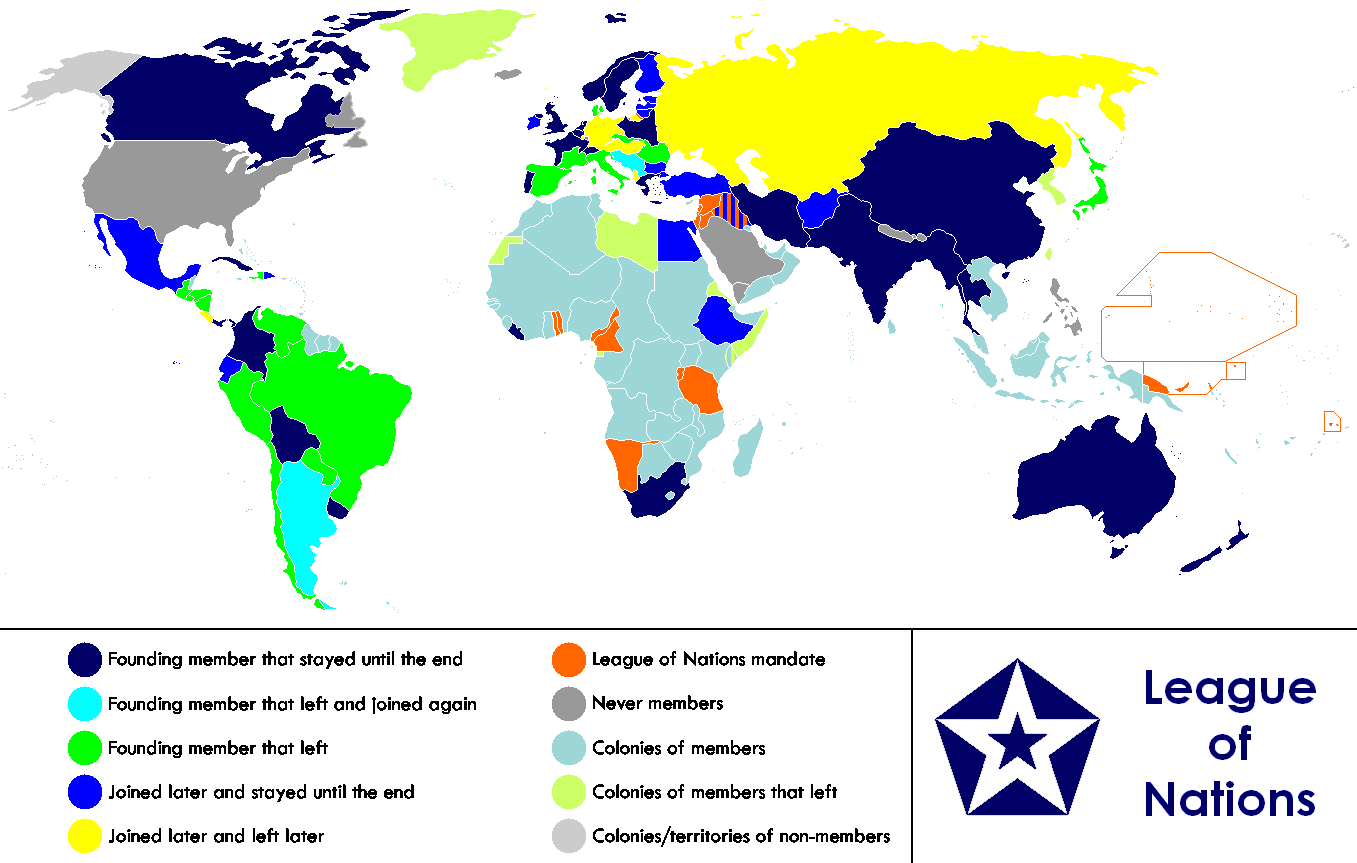
League of Nations superseded United Nations
The League of Nations, abbreviated as LN or LoN, (French: Société des Nations [sɔsjete de nɑsjɔ̃], abbreviated as “SDN” or “SdN” and meaning “Society of Nations”) was the first worldwide intergovernmental organisation whose principal mission was to maintain world peace.[1] It was founded on 10 January 1920 following the Paris Peace Conference that ended the First World War; in 1919 U.S. president Woodrow Wilson won the Nobel Peace Prize for his role as the leading architect of the League.
The organisation’s primary goals, as stated in its Covenant, included preventing wars through collective security and disarmament and settling international disputes through negotiation and arbitration.[2] Other issues in this and related treaties included labour conditions, just treatment of native inhabitants, human and drug trafficking, the arms trade, global health, prisoners of war, and protection of minorities in Europe.[3] The Covenant of the League of Nations was signed on 28 June 1919 as Part I of the Treaty of Versailles, and it became effective together with the rest of the Treaty on 10 January 1920. The first meeting of the Council of the League took place on 16 January 1920, and the first meeting of Assembly of the League took place on 15 November 1920.
The diplomatic philosophy behind the League represented a fundamental shift from the preceding hundred years. The League lacked its own armed force and depended on the victorious First World War Allies (France, the United Kingdom, Italy and Japan were the permanent members of the Executive Council) to enforce its resolutions, keep to its economic sanctions, or provide an army when needed. The Great Powers were often reluctant to do so. Sanctions could hurt League members, so they were reluctant to comply with them. During the Second Italo-Abyssinian War, when the League accused Italian soldiers of targeting Red Cross medical tents, Benito Mussolini responded that “the League is very well when sparrows shout, but no good at all when eagles fall out.”[4]
https://en.wikipedia.org/wiki/League_of_Nations