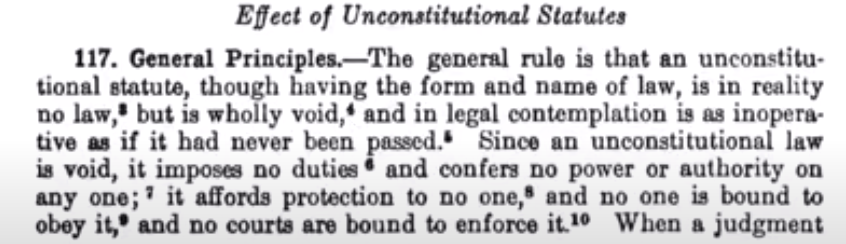
Effect of Unconstitutional Statutes

Phonology is a branch of linguistics that studies how languages or dialects systematically organize their sounds (or constituent parts of signs, in sign languages). The term also refers to the sound or sign system of any particular language variety. At one time, the study of phonology only related to the study of the systems of phonemes in spoken languages. Now it may relate to(a) any linguistic analysis either at a level beneath the word (including syllable, onset and rime, articulatory gestures, articulatory features, mora, etc.), or(b) all levels of language where sound or signs are structured to convey linguistic meaning.[1]
Sign languages have a phonological system equivalent to the system of sounds in spoken languages. The building blocks of signs are specifications for movement, location and handshape.[2]
1. the system of contrastive relationships among the speech sounds that constitute the fundamental components of a language.
UCC 1-103
UCC 1-308
UCC 9-311
TDC (Threat Duress Coercion)
The Liberty Coin Act (formally Public Law 99-51), passed in 1985 and signed into law by President Ronald Reagan, paved the way for minting millions of $1 coins made of 99.9% pure silver.
U.S. Senator James McClure of Idaho sponsored the Liberty Coin Act as a way for miners to sell surplus silver to the federal government. Aside from producing a lot of potatoes, Idaho also produces a fair amount of silver.
The 1 oz. Silver Eagle coins and others included in the Act pay tribute to the Statue of Liberty and her home, Ellis Island.
The front of the American Silver Eagle coin design is based on Adolph A. Weinman’s “Walking Liberty” half-dollar, produced from 1916 to 1947. The “Walking Liberty” half-dollar is considered one of the most beautiful American coins ever minted.
In 2021, the U.S. Mint marked the 35th anniversary of the American Eagle Coin Program with an updated design. The design now includes some of Weinman’s original details that were not previously displayed. Beginning in 2021, the back of the coin shows an eagle making a landing, carrying an oak branch it seems prepared to place in a nest.
From 1986 through the first half of 2021, the back of the coin showed a heraldic eagle with a shield, clenching an olive branch in its right talon and arrows in its left talon. The design, by John Mercanti, symbolized strength and endurance.
The American Silver Eagle coin was born as a result of the Liberty Coin Act, an amendment to the law that created the Statue of Liberty commemorative coin program.
The American Silver Eagle Coin Program, launched in 1986, wound up being one of the most popular and profitable coin programs in the history of the U.S. Mint. To date, more than 600 million of these coins have been minted.
“Today, the Silver Eagle is at the heart of the modern U.S. coin and silver bullion markets as the silver coin that has the highest demand and premiums and the greatest liquidity because of those factors,” according to CoinWeek.
Both the Liberty Coin Act and the Gold Bullion Coin Act were passed in 1985. These federal laws authorized the production of silver and gold bullion coins by the U.S. Mint. Under the Gold Bullion Coin Act, the Mint was directed to issue gold coins in $50, $25, $10, and $5 denominations. Now American Eagle Silver and American Eagle Gold coins are among the most popular coins in the world.
In British and American common law, quo warranto (Medieval Latin for “by what warrant?”) is a prerogative writ requiring the person to whom it is directed to show what authority they have for exercising some right, power, or franchise they claim to hold.
With the spread of royal justice in the 12th and 13th centuries, private franchises and liberties were increasingly called upon to uphold the king’s peace: to act against “malefactors and peace breakers, so that it may appear that you are a lover of our peace”.[1] From 1218 onwards,[2] royal Eyres also began using the old writ of quo warranto – a court order to show proof of authority, as for example (literally) “By what warrant are you the sheriff?” – to investigate the origins of such franchises.[3] An inquest of 1255 began examining such liberties nationwide;[4] and the same enquiry was taken up again by King Edward I of England in 1278, when he decreed in the Statute of Gloucester that “We must find out what is ours, and due to us, and others what is theirs, and due to them”.[5]
From one point of view this can be seen as an attempt to investigate and recover royal lands, rights, and franchises in England,[6] in particular those lost during the reign of his father, King Henry III of England.[7][8] From another, it was less of an attack on franchises as a clarification of them: in Hilda Johnstone‘s words, “Edward’s aim, it is clear, was from the first not abolition but definition”.[5]
A similar ambiguity surrounds the role of the justices that, from 1278 to 1294, Edward dispatched throughout the Kingdom of England to inquire “by what warrant” English lords claimed their liberties and exercised jurisdiction, including the right to hold a court and collect its profits. Some of the justices demanded written proof in the form of charters, others accepted a plea of “immemorial tenure”;[9] and resistance [10] and the unrecorded nature of many grants meant that eventually, by the Statute of Quo Warranto (1290), the principle was generally accepted that those rights peacefully exercised since 1189 – the beginning of the reign of Richard I, which is the legal definition in England of the phrase “time immemorial“[6][11] – were legitimate.[12]
The Quo warranto pleas from the reigns of Edward I, Edward II and Edward III were published by the Record Commission in 1818.[13]
Constructive fraud is a legal fiction describing a situation where a person or entity gained an unfair advantage over another by deceitful or unfair methods. Intent does not need to be shown[1] as in the case of actual fraud. Some unfair methods may include not telling customers about defects in a product.[2]
The elements are:[3]