8×11 paper = commerce
8×14 paper = legal
8×11 paper = commerce
8×14 paper = legal
Canada
North America
New Zealend
Austrialia
initially rejected the UNDRIP
Obligatory Powers to promote Human Rights in the 5 fields of endavor:
civil
political
economic
social
cultural
articles 55 & 56
charter of United Nations
Monetary system
Legal
Finance
Commerce
Contract
Neither paper currency nor deposits have value as commodoties
intrisiticly a dollar bill is just a piece of paper
deposits are mere book entries
modern money mechanics federal reserve bank of Chicago 1975
You are what your forefathers are/were
http://www.ecclesia.org/truth/definitions.html
Federal Reserve Notes are not dollars.” Russell L. Munk, Assistant General Counsel, Department of the Treasury, February 18, 1977.
“The term ‘dollars’ likewise is incorrect, which, according to constitutional definition, are monetary units, used in exchange, backed by gold and silver. Our present day fiat issues are supported by more printed paper of the same; therefore, they are correctly termed Federal Reserve Notes (FRN), not dollars. Robert P. Vichas, Handbook of Financial Mathematics, Formulas, and Tables (1979), p. 420.
https://supreme.justia.com/cases/federal/us/91/426/
maxim
Fraud destroys the validity of everything into which it enters
All Courts can void the constitution:
Federal
State
Local
Traffic
Family
et.al
No courts or judges since 1709
1938 eerie thomponson v. pennselvania
us delcares bankrupcty
june 5 1933 89-719
FED created jekyl island 1913
https://www.unodc.org/unodc/en/human-trafficking/what-is-human-trafficking.html
Trafficking in persons is a serious crime and a grave violation of human rights. Every year, thousands of men, women and children fall into the hands of traffickers, in their own countries and abroad. Almost every country in the world is affected by trafficking, whether as a country of origin, transit or destination for victims. UNODC, as guardian of the United Nations Convention against Transnational Organized Crime (UNTOC) and the Protocols thereto, assists States in their efforts to implement the Protocol to Prevent, Suppress and Punish Trafficking in Persons (Trafficking in Persons Protocol).
UNODC’s Response to Human Trafficking
UN Voluntary Trust Fund for Victims of Human Trafficking
Article 3, paragraph (a) of the Protocol to Prevent, Suppress and Punish Trafficking in Persons defines Trafficking in Persons as the recruitment, transportation, transfer, harbouring or receipt of persons, by means of the threat or use of force or other forms of coercion, of abduction, of fraud, of deception, of the abuse of power or of a position of vulnerability or of the giving or receiving of payments or benefits to achieve the consent of a person having control over another person, for the purpose of exploitation. Exploitation shall include, at a minimum, the exploitation of the prostitution of others or other forms of sexual exploitation, forced labour or services, slavery or practices similar to slavery, servitude or the removal of organs
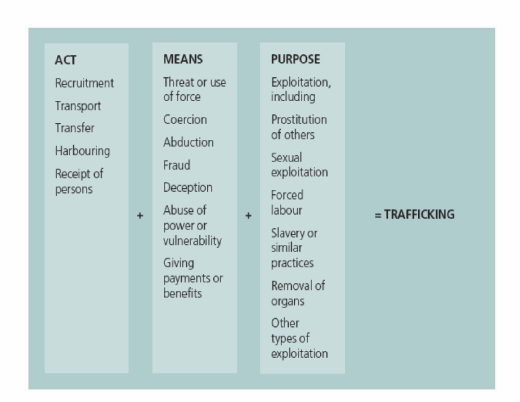
On the basis of the definition given in the Trafficking in Persons Protocol, it is evident that trafficking in persons has three constituent elements;
The Act (What is done)
Recruitment, transportation, transfer, harbouring or receipt of persons
The Means (How it is done)
Threat or use of force, coercion, abduction, fraud, deception, abuse of power or vulnerability, or giving payments or benefits to a person in control of the victim
The Purpose (Why it is done)
For the purpose of exploitation, which includes exploiting the prostitution of others, sexual exploitation, forced labour, slavery or similar practices and the removal of organs.
To ascertain whether a particular circumstance constitutes trafficking in persons, consider the definition of trafficking in the Trafficking in Persons Protocol and the constituent elements of the offense, as defined by relevant domestic legislation.
The definition contained in article 3 of the Trafficking in Persons Protocol is meant to provide consistency and consensus around the world on the phenomenon of trafficking in persons. Article 5 therefore requires that the conduct set out in article 3 be criminalized in domestic legislation. Domestic legislation does not need to follow the language of the Trafficking in Persons Protocol precisely, but should be adapted in accordance with domestic legal systems to give effect to the concepts contained in the Protocol.
In addition to the criminalization of trafficking, the Trafficking in Persons Protocol requires criminalization also of:
· Attempts to commit a trafficking offence
· Participation as an accomplice in such an offence
· Organizing or directing others to commit trafficking.
National legislation should adopt the broad definition of trafficking prescribed in the Protocol. The legislative definition should be dynamic and flexible so as to empower the legislative framework to respond effectively to trafficking which:
· Occurs both across borders and within a country (not just cross-border)
· Is for a range of exploitative purposes (not just sexual exploitation)
· Victimizes children, women and men (Not just women, or adults, but also men and children)
· Takes place with or without the involvement of organized crime groups.
For a checklist of Criminalization under the Protocol, click here.
For more resources, visit our Publications page.
To see how human trafficking is different to migrant smuggling, click here.