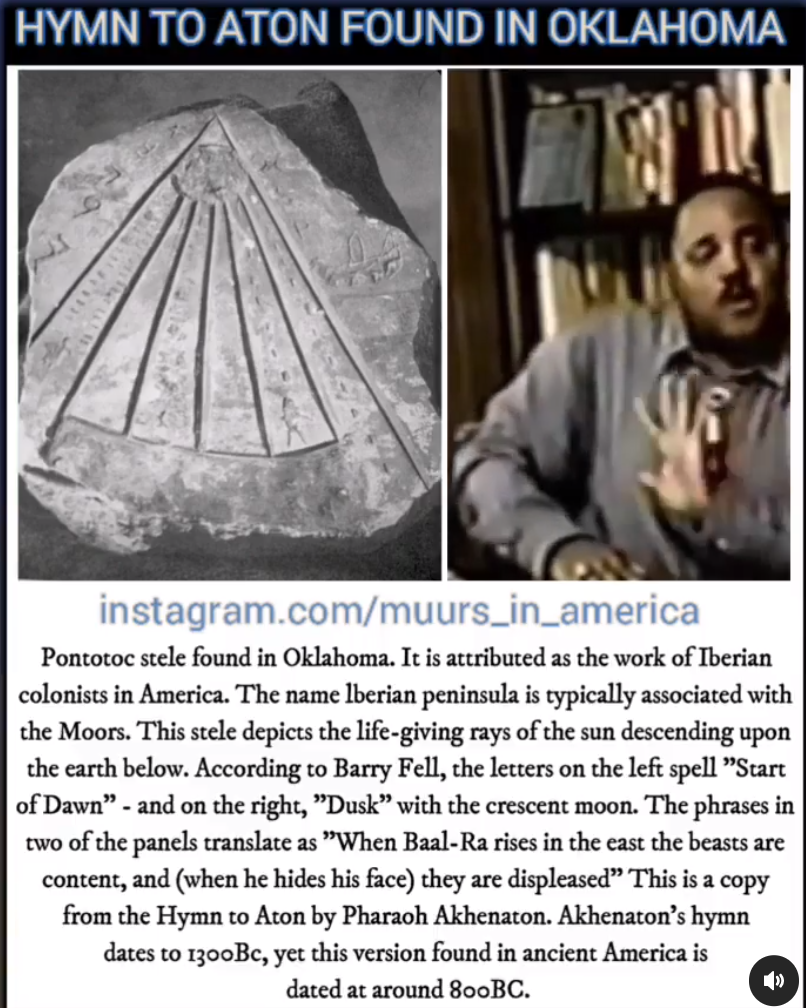

Pontotoc stele found in Oklahoma. It is attributed as the work of Iberian colonists in America. The name Iberian peninsula is typically associated with the African Moor. This stele depicts the life-giving rays of the sun descending upon the earth below. According to Barry Fell, the letters on the left spell “Start of Dawn” – and on the right, “Dusk” with the crescent moon. The phrases in two of the panels translate as “When Ball-Ra rises in the east, the beasts are content, and (when he hides his face) they are displeased.” This is a copy from the Hymn to Aton by Pharaoh Akhenaton. Akhenaton’s hymn dates to 1300BC, yet this version found in ancient America is dated at around 800BC.
Source: https://isikuro.tumblr.com/post/39752108625/pontotoc-stele-found-in-oklahoma-it-is-attributed
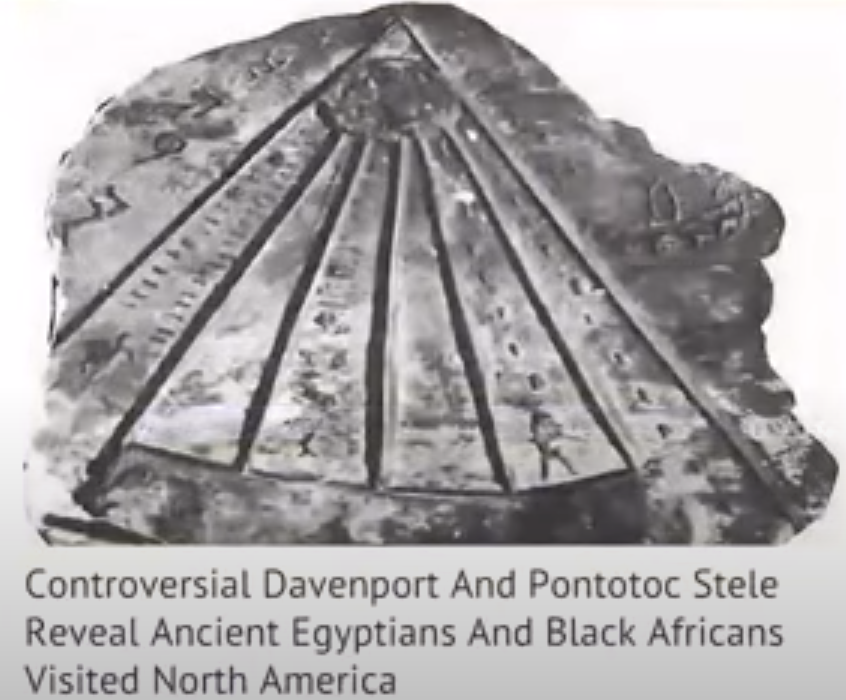
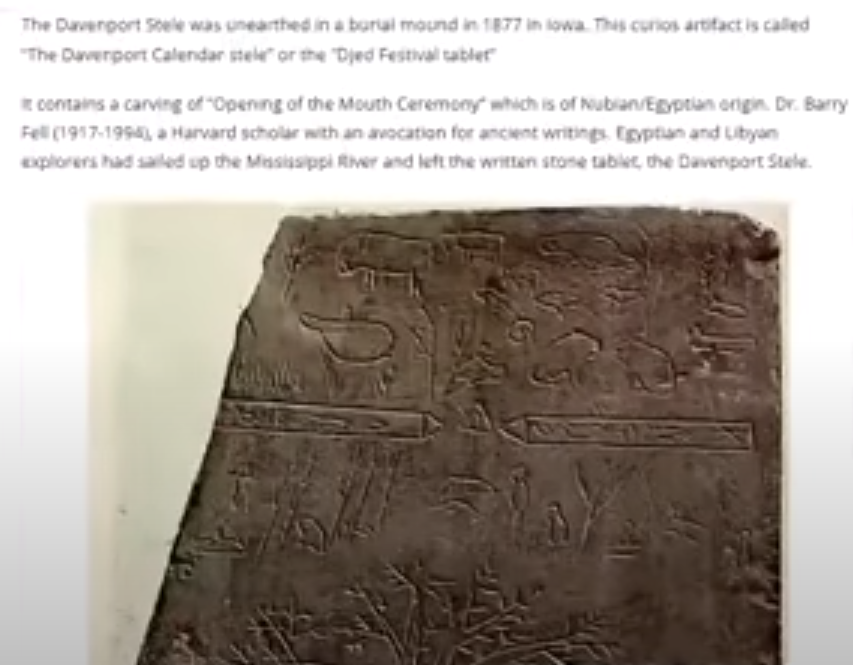
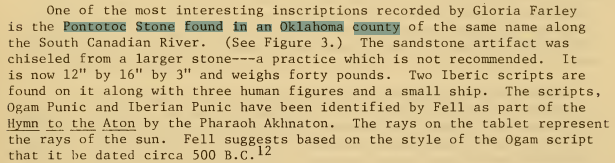
In addition, he has allegedly translated the so-called Pontotoc stele of Oklahoma as an extract from the “Hymn to Aton”, a chant of the pharaoh Akhnaton, dating from the 13th century B.C., although Fell says the Oklahoma version can scarcely be older than about 800 B.C., believing it was the work of an early Iberian colonist writing in the script from the Cachao-da-Rapa region of northern Portugal. Similarly he writes that the Davenport stele of Iowa has three separate scripts,- Egyptian hieroglyphics alongside Iberian and Libyan scripts. Previously these stelae had been considered as fakes. Fell’s interesting hypotheses have not yet been generally accepted and seem to have been more or less ignored by the professional archeologists. (Ref. 122)
In the Cochise area of southwest United States a new and more vigorous strain of corn was imported from Mexico about 1,000 B.C. A new plant, the red kidney bean, also appeared as the Cochise began to build simple pit-houses and group themselves together in small villages. As agricultural activities made easier living, they had time to develop early pottery forms and soon figurines of people and animals. Findings in the refuse of the Ventana Cave, some 100 miles from Tucson, have revealed these gradual changes from hunter to farmer. (Ref. 210)
https://cnx.org/contents/Rax-UuAp@2.1:0rZjcuyW@2/America-1000-to-700-B-C