asylum (n.)

early 15c., earlier asile (late 14c.), “place of refuge, sanctuary,” from Latin asylum “sanctuary,” from Greek asylon “refuge, fenced territory,” noun use of neuter of asylos “inviolable, safe from violence,” especially of persons seeking protection, from a- “without” (see a- (3)) + sylē “right of seizure,” which is of unknown etymology.

Literally, “an inviolable place.” Formerly a place where criminals and debtors sought shelter from justice and from which they could not be taken without sacrilege. General sense of “safe or secure place” is from 1640s; abstract sense “inviolable shelter, protection from pursuit or arrest” is from 1712. Meaning “benevolent institution to shelter some class of persons suffering social, mental, or bodily defects” is from 1773, originally of female orphans.
General Education Board

The General Education Board was a philanthropic non-governmental organization which was used primarily to support higher education and medical schools in the United States, and to help rural white and black schools in the South, as well as modernize farming practices in the South. It helped eradicate hookworm and created the county agent system in American agriculture, linking research as state agricultural experiment stations with actual practices in the field.

The Board was created in 1902 after John D. Rockefeller donated an initial $1,000,000 dollars to its cause. The Rockefeller family would eventually give over $180 million to fund the General Education Board. Prominent member Frederick Taylor Gates envisioned “The Country School of To-Morrow,” wherein “young and old will be taught in practicable ways how to make rural life beautiful, intelligent, fruitful, re-creative, healthful, and joyous.”[1] By 1934 the Board was making grants of $5.5 million a year. It spent nearly all its money by 1950 and closed in 196
https://en.wikipedia.org/wiki/General_Education_Board

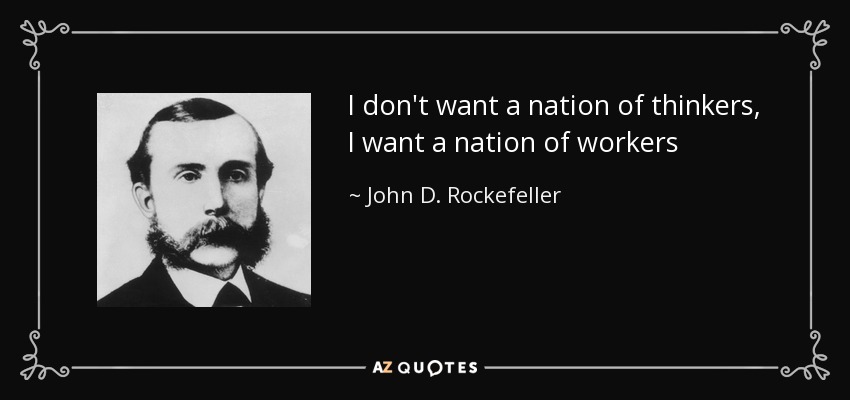
John D. Rockefeller quote: I don't want a nation of thinkers, I want a...

https://en.wikipedia.org/wiki/General_Education_Board

Index Librorum Prohibitorm Expurgatorius

Index Librorum Expurgatorius
aka
The Great Book burning

The Index Librorum Prohibitorum (“List of Prohibited Books”) was a list of publications deemed heretical or contrary to morality by the Congregation for the Doctrine of the Faith (a former Dicastery of the Roman Curia), and Catholics were forbidden to read them.[1]

There were attempts to ban heretical books before the sixteenth century, notably in the ninth-century Decretum Glasianum; the Index of Prohibited Books of 1560 banned thousands of book titles and blacklisted publications, including the works of Europe’s intellectual elites.[2][3][4] The 20th and final edition of the index appeared in 1948, and the Index was formally abolished on 14 June 1966 by Pope Paul VI.[5][6]

heir (n.)

“one who inherits, or has right of inheritance in, the property of another,” c. 1300, from Anglo-French heir, Old French oir “heir, successor; heritage, inheritance,” from Latin heredem (nominative heres) “heir, heiress” (see heredity). Heir apparent (late 14c.) has the French order of noun-adjective, though it was not originally so written in English. It is the heir of one still alive whose right is clear. After death the heir apparent becomes the heir-at-law. Related: Heir-apparency.

Gold Cost

Gold Spot PricesGold PriceSpot Change
Gold Price Per Ounce$1,742.80($9.00)
Gold Price Per Gram$56.03($0.29)
Gold Price Per Kilo$56,032.28($289.36)

For example, today a 1 oz American Gold Eagle coin may be bought from a dealer for $1355. That same dealer is also offering a 1 oz OPM gold bar for $1323.

Live Metal Spot Price (24hrs) Apr 12, 2021 at 09:08 EST.

Gold Spot PricesTodayChange
Gold Price Per Ounce$ 1,745.37-5.22
Gold Price Per Gram$ 56.11-0.17

solace (n.)

“comfort in grief, consolation,” late 13c., from Old French solaz “pleasure, entertainment, enjoyment; solace, comfort,” from Latin solacium “a soothing, assuaging; comfort, consolation,” from solatus, past participle of solari “to console, soothe,” from a suffixed form of PIE root *selh- “to reconcile” (source also of Greek hilaros). Adjectival form solacious is attested 16c.-17c.