1510s, “condition of being at one (with others),” a sense now obsolete, from atone + -ment. Theological meaning “reconciliation” (of man with God through the life, passion, and death of Christ) is from 1520s; that of “satisfaction or reparation for wrong or injury, propitiation of an offended party” is from 1610s.
Month: March 2021
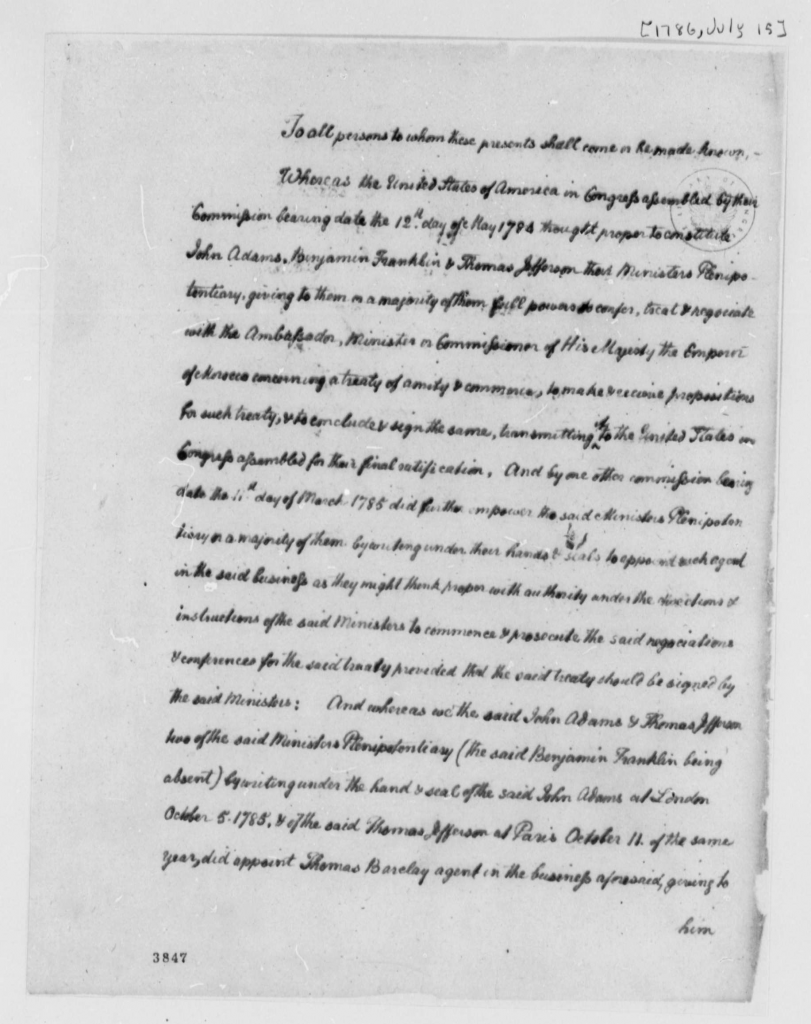
Treaty of Peace Friendship Treaty of Peace Friendship 1787 Between Morocco and The United States
http://rvbeypublications.com/sitebuildercontent/sitebuilderfiles/treatyofpeacefriendship.pdf
Constitution for the United States: 1788 ratified 1789
Article 6 American Constitution secures this.
From George Washington to Sidi Mohammed, 1 December 1789
Since the Date of the Letter, which the late Congress, by their President, addressed to your Imperial Majesty, the United States of America have thought proper to change their Government, and to institute a new one, agreeable to the Constitution, of which I have the Honor of, herewith, enclosing a Copy. The Time necessarily employed in this arduous Task, and the Derangements occasioned by so great, though peaceable a Revolution, will apologize, and account for your Majesty’s not having received those regular Advices, and Marks of Attention, from the United States, which the Friendship and Magnanimity of your Conduct, towards them, afforded Reason to expect.
https://founders.archives.gov/documents/Washington/05-04-02-0251
Northwest Ordinance 1787
The Northwest Ordinance (formally An Ordinance for the Government of the Territory of the United States, North-West of the River Ohio, and also known as The Ordinance of 1787) enacted July 13, 1787, was an organic act of the Congress of the Confederation of the United States. It created the Northwest Territory, the new nation’s first organized incorporated territory, from lands beyond the Appalachian Mountains, between British North America and the Great Lakes to the north and the Ohio River to the south. The upper Mississippi River formed the territory’s western boundary. Pennsylvania was the eastern boundary.
In the 1783 Treaty of Paris, which formally ended the American Revolutionary War, Great Britain yielded the region to the United States. However, the Confederation Congress faced numerous problems gaining control of the land such as the unsanctioned movement of American settlers into the Ohio Valley; violent confrontations with the region’s indigenous peoples; the ongoing presence of the British Army, which continued to occupy forts in the region; and an empty U.S. treasury.[1] The ordinance superseded the Land Ordinance of 1784, which declared that states would one day be formed within the region, and the Land Ordinance of 1785, which described how the Confederation Congress would sell the land to private citizens. Designed to serve as a blueprint for the development and settlement of the region, the 1787 ordinance lacked a strong central government to implement it. That need was addressed shortly by the U.S. federal government formed in 1789. The First Congress reaffirmed the 1787 ordinance and, with slight modifications, renewed it by the Northwest Ordinance of 1789.[2]
Considered one of the most important legislative acts of the Confederation Congress,[3] it established the precedent by which the federal government would be sovereign and expand westward with the admission of new states, rather than with the expansion of existing states and their established sovereignty under the Articles of Confederation. It also set legislative precedent with regard to American public domain lands.[4] The U.S. Supreme Court recognized the authority of the Northwest Ordinance of 1789 within the applicable Northwest Territory as constitutional in Strader v. Graham,[5] but it did not extend the ordinance to cover the respective states once they were admitted to the Union.
The prohibition of slavery in the territory had the practical effect of establishing the Ohio River as the geographic divide between slave states and free states from the Appalachian Mountains to the Mississippi River, an extension of the Mason–Dixon line. It also helped set the stage for later federal political conflicts over slavery during the 19th century until the American Civil War.
https://en.wikipedia.org/wiki/Northwest_Ordinance
Treaty being made
before the adoption of the constitution
determination of how indigenous people would be treated
Then constitution adopted in 88, signed and ratified in 89
Confederacy
Articles of Confederation modified
Republic order set in 81, John Hanson
Great Seal cast for him
Former Pres. Obama + Muslim (Moors)acknowledgement
The Barbary Treaties 1786-1816
Treaty of Peace and Friendship, Signed at Tripoli November 4, 1796
https://avalon.law.yale.edu/18th_century/bar1796t.asp
ARTICLE 11.
As the government of the United States of America is not in any sense founded on the Christian Religion,-as it has in itself no character of enmity against the laws, religion or tranquility of Musselmen,-and as the said States never have entered into any war or act of hostility against any Mehomitan nation, it is declared by the parties that no pretext arising from religious opinions shall ever produce an interruption of the harmony existing between the two countries.
Muslims = Moors
Wars, Government, Civil Rights, Started Businesses (Black Wall Street – Tulsa,OK), Universities, Excelled in Sports Arenas, Nobel Prizes, Tallest Building & Lit Olympic Torches
Former Pres. Obama UNDRIP
“For the first Americans and for all Americans”
E pluribus unum
E pluribus unum – Latin for “Out of many, one” – is a traditional motto of the United States, appearing on the Great Seal along with Annuit cœptis and Novus ordo seclorum; its inclusion on the seal was approved by an Act of Congress in
We shall not oppress a stranger: Former Pres. Obama
ipso jure
meaning: as the law stands
append (v.)
late 14c., “to belong to as a possession or right,” from Old French apendre (13c.) “belong, be dependent (on); attach (oneself) to; hang, hang up,” and directly from Latin appendere “cause to hang (from something); weigh out,” from ad “to” (see ad-) + pendere “to hang, cause to hang; weight; pay” (from PIE root *(s)pen- “to draw, stretch, spin”).
Meaning “to hang on, attach as a pendant” is 1640s; that of “attach as an appendix” is recorded by 1843. OED says the original word was obsolete by c. 1500, and these later transitive senses thus represent a reborrowing from Latin or French. Related: Appended; appending.