Courts cite to stare decisis when an issue has been previously brought to the court and a ruling already issued. According to the Supreme Court, stare decisis “promotes the evenhanded, predictable, and consistent development of legal principles, fosters reliance on judicial decisions, and contributes to the actual and perceived integrity of the judicial process.” In practice, the Supreme Court will usually defer to its previous decisions even if the soundness of the decision is in doubt. A benefit of this rigidity is that a court need not continuously reevaluate the legal underpinnings of past decisions and accepted doctrines. Moreover, proponents argue that the predictability afforded by the doctrine helps clarify constitutional rights for the public. Other commentators point out that courts and society only realize these benefits when decisions are published and made available. Thus, some scholars assert that stare decisis is harder to justify in cases involving secret opinions.
Month: October 2020
Novelty Law
The term novelty signifies that an invention must never have been made public in any way, anywhere, before the date on which the application for a patent is filed Novelty is an important requirement for patentability. If an invention has been used or was known to others it is not considered as novel and therefore not eligible for patent protection.
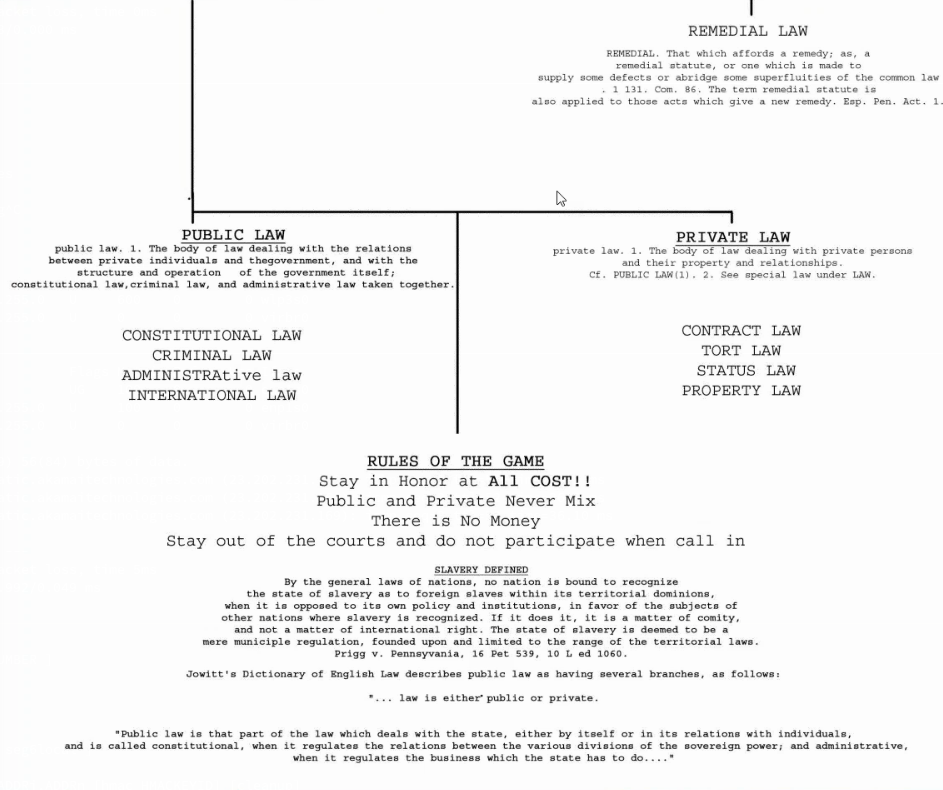
Public law
Public law is the part of law that governs relationships between legal persons and a government,[1] between different institutions within a state, between different branches of governments,[2] and relationships between persons that are of direct concern to society. Public law comprises constitutional law, administrative law, tax law and criminal law,[1] as well as all procedural law. (Laws concerning relationships between individuals belong to private law.)
The relationships public law governs are asymmetric and unequal. Government bodies (central or local) can make decisions about the rights of persons. However, as a consequence of the rule-of-law doctrine, authorities may only act within the law (secundum et intra legem). The government must obey the law. For example, a citizen unhappy with a decision of an administrative authority can ask a court for judicial review.
Rights, too, can be divided[by whom?] into private rights and public rights. A paragon of a public right is the right to welfare benefits – only a natural person can claim such payments, and they are awarded through an administrative decision out of the government budget.
The distinction between public law and private law dates back to Roman law, where the Roman jurist Ulpian (c. 170 – 228) first noted it.[3] It was later[when?] adopted[by whom?] to understand the legal systems both of countries that adhere to the civil-law tradition, and of those that adhere to common-law tradition.
https://en.wikipedia.org/wiki/Public_law
The borderline between public law and private law is not always clear. Law as a whole cannot neatly be divided into “law for the State” and “law for everyone else”. As such, the distinction between public and private law is largely functional rather than factual, classifying laws according to which domain the activities, participants, and principle concerns involved best fit into.[2] This has given rise to attempts to establish a theoretical understanding for the basis of public law.
Rule 24. Intervention
(a) Intervention of Right. On timely motion, the court must permit anyone to intervene who:
(1) is given an unconditional right to intervene by a federal statute; or
(2) claims an interest relating to the property or transaction that is the subject of the action, and is so situated that disposing of the action may as a practical matter impair or impede the movant’s ability to protect its interest, unless existing parties adequately represent that interest.
(b) Permissive Intervention.
(1) In General. On timely motion, the court may permit anyone to intervene who:
(A) is given a conditional right to intervene by a federal statute; or
(B) has a claim or defense that shares with the main action a common question of law or fact.
(2) By a Government Officer or Agency. On timely motion, the court may permit a federal or state governmental officer or agency to intervene if a party’s claim or defense is based on:
(A) a statute or executive order administered by the officer or agency; or
(B) any regulation, order, requirement, or agreement issued or made under the statute or executive order.
(3) Delay or Prejudice. In exercising its discretion, the court must consider whether the intervention will unduly delay or prejudice the adjudication of the original parties’ rights.
(c) Notice and Pleading Required. A motion to intervene must be served on the parties as provided in Rule 5. The motion must state the grounds for intervention and be accompanied by a pleading that sets out the claim or defense for which intervention is sought.
Vocabulary
Allodium
Certiorari
Asset Currency
Commerce
Declaration of Trusts
Distributable Net Income
Indenture
Perpetuity
Tax Haven
*Property
Right
Trust
Fee Simple
Alienation
Tort
Doctrine of Merger
In the law of real property, the merger doctrine stands for the proposition that the contract for the conveyance of property merges into the deed of conveyance; therefore, any guarantees made in the contract that are not reflected in the deed are extinguished when the deed is conveyed to the buyer of the property.
The merger doctrine traditionally applies only to covenants of title; covenants relating to the physical condition of the property (say, a promise that the furnace is in good working order) will not merge, and will not extinguish. The parties may by contract abrogate the doctrine and provide that some or all terms of the contract survive the closing and delivery of the deed.[citation needed]
Merger also refers to the doctrine whereby “a fee simple estate, once fragmented into present and future interests, can thereafter be reconstituted. ‘Merger is the absorption of a lesser estate by a greater estate, and takes place when two distinct estates of greater and lesser rank meet in the same person or class of persons at the same time without any intermediate estate.’ “[1] Similarly, a merger doctrine extinguishes an easement by necessity to a landlocked piece of property once that property is sold to one of the adjoining owners, thus extinguishing the necessity. The lack of any property interest removes the necessity and the easement.
https://en.wikipedia.org/wiki/Merger_doctrine_(property_law)
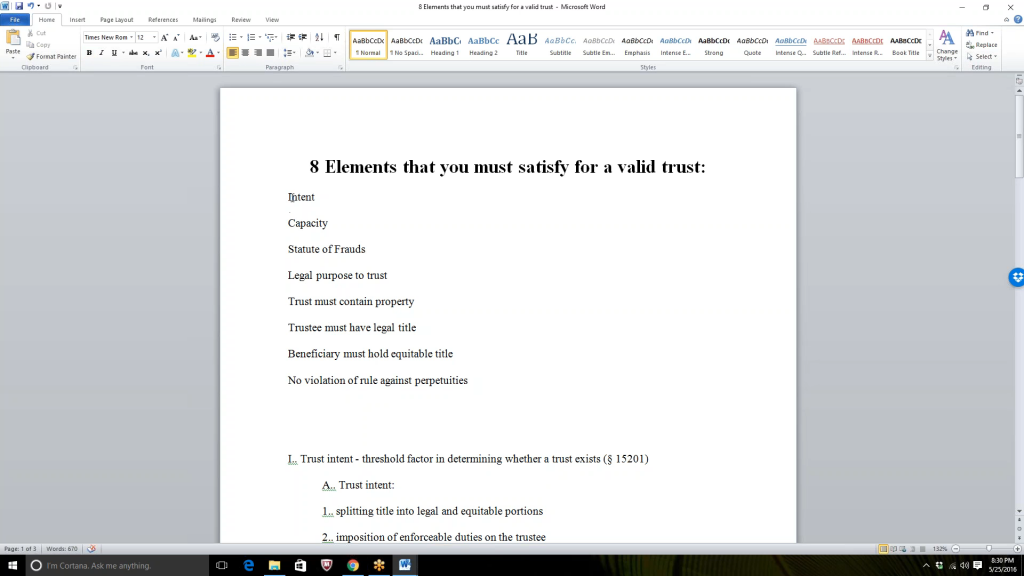
8 elements to satisfy a valid trust