Month: October 2020
Compelling Public Interests
Compelling-state-interest-test refers to a method of determining the constitutional validity of a law. Under this test, the government’s interest is balanced against the individual’s constitutional right to be free of law. However, a law will be upheld only if the government’s interest is strong enough.
In Howe v. Brown, 319 F. Supp. 862 (N.D. Ohio 1970), it was held that, the compelling-state-interest-test is mostly applied in all voting rights cases and equal protection cases. It is also applied when a disputed law requires strict scrutiny.
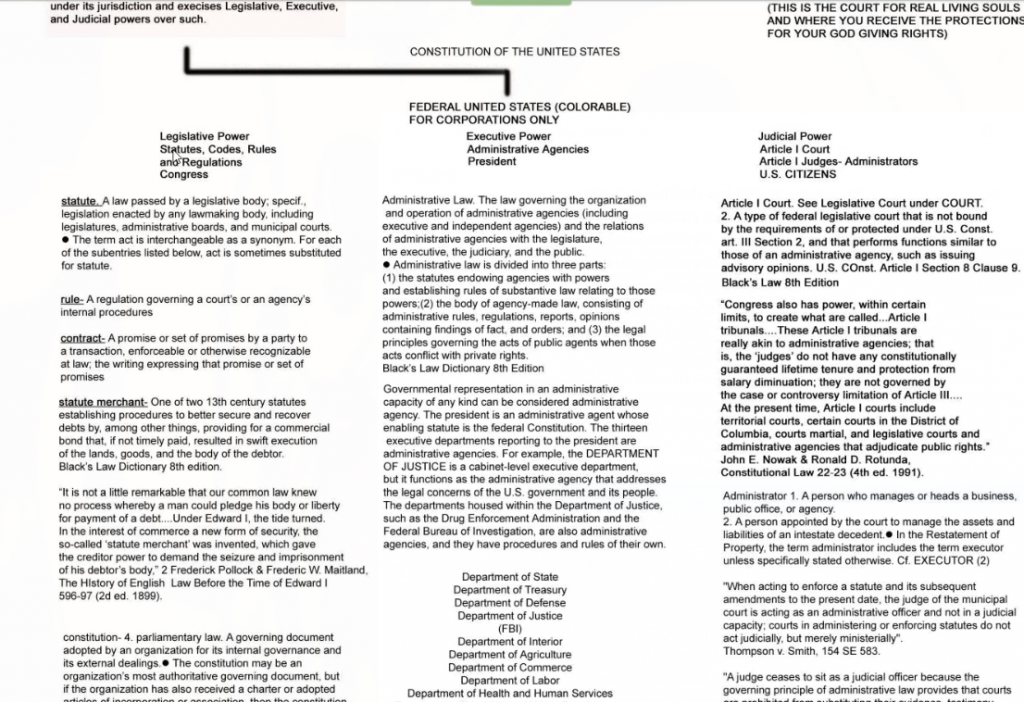
Article III Court = Constitutional Courts
Promulgation
PROMULGATION. The order given to cause a law to be executed, and to make it public it differs from publication. (q.v.) 1 Bl. Com. 45; Stat. 6 H. VI., c. 4.
2. With regard to trade, unless previous notice can be brought home to the party charged with violating their provisions, laws are to be considered as beginning to operate in the respective collection districts only from the time they are received from the proper department by the collector. Paine’s C. C. R. 32. See Paine’s C. C. R. 2 3.
Restatement on the Law of Trust
Ashwander rules
The Ashwander rules, articulated by Justice Louis D. Brandeis, are a set of principles used by the United States Supreme Court for avoiding constitutional rulings.
Rules for Judicial Self-Restraint and Avoiding Constitutional Questions
Justice Louis D. Brandeis, concurring in Ashwander v. Tennessee Valley Authority, 297 U.S. 288 (1936), summarized some prudential rules for exercising judicial self-restraint and avoiding ruling on the constitutionality of congressional legislation:
The Court developed, for its own governance in the cases confessedly within its jurisdiction, a series of rules under which it has avoided passing upon a large part of all the constitutional questions pressed upon it for decision. They are:
- The Court will not pass upon the constitutionality of legislation in a friendly, non-adversary, proceeding, declining because to decide such questions “is legitimate only in the last resort, earnest and vital controversy between individuals. It never was the thought that, by means of a friendly suit, a party beaten in the legislature could transfer to the courts an inquiry as to the constitutionality of the legislative act.”[1]
- The Court will not “anticipate a question of constitutional law in advance of the necessity of deciding it.” [2] “It is not the habit of the Court to decide questions of a constitutional nature unless absolutely necessary to a decision of the case.” [3]
- The Court will not “formulate a rule of constitutional law broader than is required by the Precise facts to which it is to be applied.” [2]
- The Court will not pass upon a constitutional question although properly presented by the record, if there is also present some other ground upon which the case may be disposed of. This rule has found most varied application. Thus, if a case can be decided on either of two grounds, one involving a constitutional question, the other a question of statutory construction or general law, the Court will decide only the latter. Appeals from the highest court of a state challenging its decision of a question under the Federal Constitution are frequently dismissed because the judgment can be sustained on an independent state ground.
- The Court will not pass upon the validity of a statute upon complaint of one who fails to show that he is injured by its operation. Among the many applications of this rule, none is more striking than the denial of the right to challenge to one who lacks a personal or property right. (While not mentioned in Ashwander, there are exceptions in the case of a First Amendment challenge where the party may raise the effect of a law on other person’s First Amendment rights, the so-called “chilling effect” doctrine.)
- The Court will not pass upon the constitutionality of a statute at the instance of one who has availed himself of its benefits.
- “When the validity of an act of the Congress is drawn in question, and even if a serious doubt of constitutionality is raised, it is a cardinal principle that this Court will first ascertain whether a construction of the statute is fairly possible by which the question may be avoided.” [4]
Trust
Enforced in equity
Rule 24. Intervention
https://www.law.cornell.edu/rules/frcp/rule_24
(a) Intervention of Right. On timely motion, the court must permit anyone to intervene who:
(1) is given an unconditional right to intervene by a federal statute; or
(2) claims an interest relating to the property or transaction that is the subject of the action, and is so situated that disposing of the action may as a practical matter impair or impede the movant’s ability to protect its interest, unless existing parties adequately represent that interest.
(b) Permissive Intervention.
(1) In General. On timely motion, the court may permit anyone to intervene who:
(A) is given a conditional right to intervene by a federal statute; or
(B) has a claim or defense that shares with the main action a common question of law or fact.
(2) By a Government Officer or Agency. On timely motion, the court may permit a federal or state governmental officer or agency to intervene if a party’s claim or defense is based on:
(A) a statute or executive order administered by the officer or agency; or
(B) any regulation, order, requirement, or agreement issued or made under the statute or executive order.
(3) Delay or Prejudice. In exercising its discretion, the court must consider whether the intervention will unduly delay or prejudice the adjudication of the original parties’ rights.
(c) Notice and Pleading Required. A motion to intervene must be served on the parties as provided in Rule 5. The motion must state the grounds for intervention and be accompanied by a pleading that sets out the claim or defense for which intervention is sought.
Public Law 97-280
https://en.wikisource.org/wiki/Public_Law_97-280
Whereas the Bible, the Word of God, has made a unique contribution in shaping the United States as a distinctive and blessed nation and people;
Whereas deeply held religious convictions springing from the Holy Scriptures led to the early settlement of our Nation;
Whereas Biblical teachings inspired concepts of civil government that are contained in our Declaration of Independence and the Constitution of the United States;
Whereas many of our great national leaders-among them Presidents Washington, Jackson, Lincoln, and Wilson-paid tribute to the surpassing influence of the Bible in our country’s development, as in the words of President Jackson that the Bible is “the rock on which our Republic rests”;
Whereas the history of our Nation clearly illustrates the value of voluntarily applying the teachings of the Scriptures in the lives of individuals, families, and societies;
Whereas this Nation now faces great challenges that will test this Nation as it has never been tested before; and
Whereas that renewing our knowledge of and faith in God through Holy Scripture can strengthen us as a nation and a people:
Now, therefore, be itResolved by the Senate and House of Representatives of the United States of America in Congress assembled,That the President is authorized and requested to designate 1983 as a national “Year of the Bible” in recognition of both the formative influence the Bible has been for our Nation, and our national need to study and apply the teachings of the Holy Scriptures.
Approved October 4, 1982.