Amahzeir
Amazeer
Berbers
Nuwabiean
= Moors
Amahzeir
Amazeer
Berbers
Nuwabiean
= Moors
Every person who, having knowledge that any of the wrongs conspired to be done, and mentioned in section 1985 of this title, are about to be committed, and having power to prevent or aid in preventing the commission of the same, neglects or refuses so to do, if such wrongful act be committed, shall be liable to the party injured, or his legal representatives, for all damages caused by such wrongful act, which such person by reasonable diligence could have prevented; and such damages may be recovered in an action on the case; and any number of persons guilty of such wrongful neglect or refusal may be joined as defendants in the action; and if the death of any party be caused by any such wrongful act and neglect, the legal representatives of the deceased shall have such action therefor, and may recover not exceeding $5,000 damages therein, for the benefit of the widow of the deceased, if there be one, and if there be no widow, then for the benefit of the next of kin of the deceased. But no action under the provisions of this section shall be sustained which is not commenced within one year after the cause of action has accrued.(R.S. § 1981.)
in the Facebook sense, attested from 2005, from the noun. Friend occasionally has been used as a verb in English since c. 1200 (“to be friends”), though the more usual verb for “join in friendship, act as a friend” is befriend. Related: Friended; friending. Old English had freonsped “an abundance of friends” (see speed (n.)); freondleast “want of friends;” freondspedig “rich in friends.”
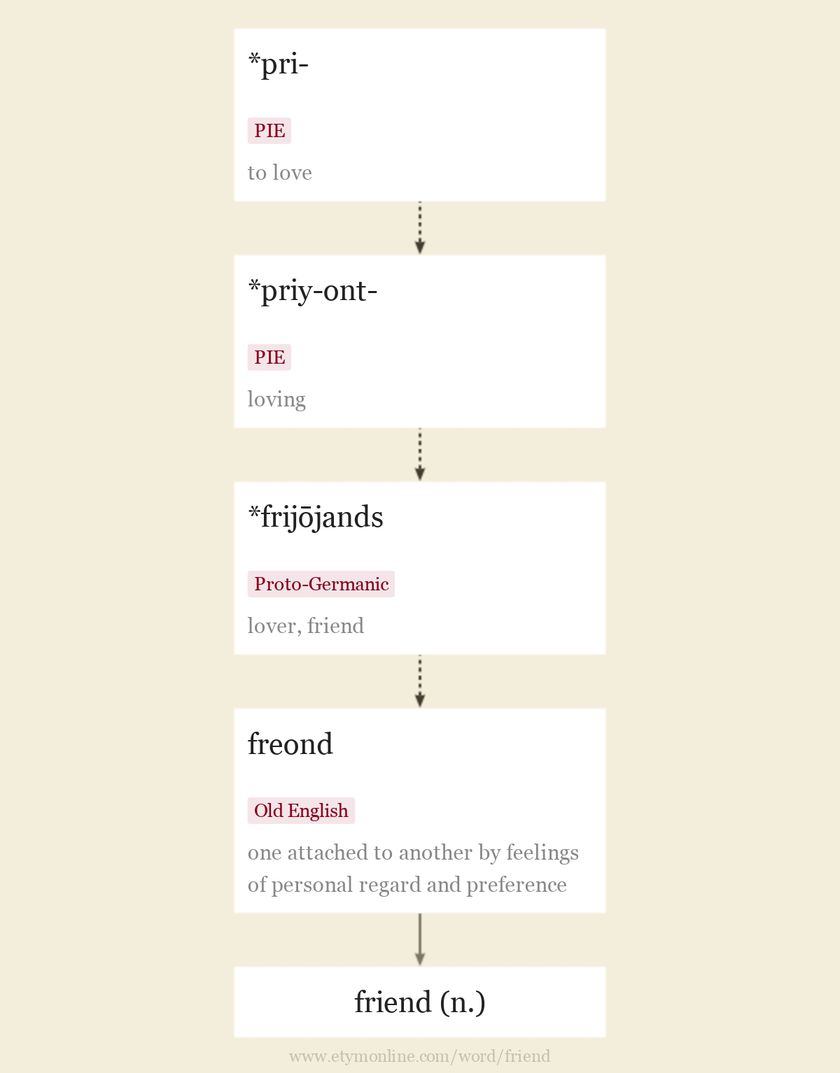
Old English freond “one attached to another by feelings of personal regard and preference,” from Proto-Germanic *frijōjands “lover, friend” (source also of Old Norse frændi, Old Danish frynt, Old Frisian friund, Dutch vriend, Middle High German friunt, German Freund, Gothic frijonds “friend”), from PIE *priy-ont-, “loving,” present-participle form of root *pri- “to love.”
Meaning “a Quaker” (a member of the Society of Friends) is from 1670s. Feond (“fiend,” originally “enemy”) and freond often were paired alliteratively in Old English; both are masculine agent nouns derived from present participle of verbs, but they are not directly related to one another (see fiend). Related: Friends.
title 39 usc 601
(a)A letter may be carried out of the mails when—(1)it is enclosed in an envelope;(2)the amount of postage which would have been charged on the letter if it had been sent by mail is paid by stamps, or postage meter stamps, on the envelope;(3)the envelope is properly addressed;(4)the envelope is so sealed that the letter cannot be taken from it without defacing the envelope;(5)any stamps on the envelope are canceled in ink by the sender; and(6)the date of the letter, of its transmission or receipt by the carrier is endorsed on the envelope in ink.(b)A letter may also be carried out of the mails when—(1)the amount paid for the private carriage of the letter is at least the amount equal to 6 times the rate then currently charged for the 1st ounce of a single-piece first class letter;(2)the letter weighs at least 12½ ounces; or(3)such carriage is within the scope of services described by regulations of the United States Postal Service (including, in particular, sections 310.1 and 320.2–320.8 of title 39 of the Code of Federal Regulations, as in effect on July 1, 2005) that purport to permit private carriage by suspension of the operation of this section (as then in effect).(c)Any regulations necessary to carry out this section shall be promulgated by the Postal Regulatory Commission.(Pub. L. 91–375, Aug. 12, 1970, 84 Stat. 727; Pub. L. 109–435, title V, § 503(a), Dec. 20, 2006, 120 Stat. 3234.)
Agbetu emerged on the international stage on 27 March 2007, during a Westminster Abbey church service held to recognize the 200th anniversary of Great Britain‘s Abolition of the Slave Trade Act 1807. Queen Elizabeth II was in attendance at the commemorative event, which marked the British government’s decision to end the Atlantic Slave Trade, although slavery in British colonies would continue until 1834.[2][3]
In a dramatic display, Agbetu slipped past security guards at the 2007 service and strode into the open area in front of the church altar, standing three metres away from the queen and shouting that the service was an insult to those of African heritage. In subsequent interviews he called the service a self-congratulatory exercise for those who promote oppression and those who continued to prevent the social and intellectual freedom of oppressed peoples. As reported in major media, he yelled at the queen: “‘You should be ashamed. We should not be here. This is an insult to us. I want all the Christians who are Africans to walk out of here with me!'”[4] He was wrestled to the floor by security guards and removed from the church.
Subsequently, a storm of media interest erupted, much of it negative.[5] The Crown Prosecution Service advised that no charges be brought against him.[6] Agbetu’s intervention has been described as “an iconic moment in the modern history of African emancipation struggles”.[7] Agbetu himself later explained in The Guardian what happened from his perspective:
Fractional-reserve banking is the most common form of banking practised by commercial banks worldwide.[1] It involves banks accepting deposits from customers and making loans to borrowers, while holding in reserve an amount equal to only a fraction of the bank’s deposit liabilities.[2] Bank reserves are held as cash in the bank or as balances in the bank’s account at the central bank. The minimum amount that banks are required to hold in liquid assets is determined by the country’s central bank, and is called the reserve requirement or reserve ratio. Banks usually hold more than this minimum amount, keeping excess reserves.
Bank deposits are usually of a relatively short-term duration while loans made by banks tend to be longer-term – this requires banks to hold reserves to provide liquidity when deposits are withdrawn. Banks, working on the expectation that only a proportion of depositors will seek to withdraw funds at the same time, keep only a fraction of their liabilities as reserves. Thus, they can experience an unexpected bank run, when depositors wish to withdraw more funds than the reserves held by the bank. In that event, the bank experiencing the liquidity shortfall may borrow from other banks in the interbank lending market; or if there is a general lack of liquidity among the banks, the country’s central bank may act as lender of last resort to provide banks with funds to cover this short-term shortfall.[2][3]
Because banks hold reserves in amounts that are less than the amounts of their deposit liabilities, and because the deposit liabilities are considered money in their own right, fractional-reserve banking permits the money supply to grow beyond the amount of the underlying base money originally created by the central bank.[2][3] In most countries, the central bank (or other monetary policy authority) regulates bank credit creation, imposing reserve requirements and capital adequacy ratios. This helps ensure that banks are solvent and have enough funds to meet demand for withdrawals, and can be used to limit the process of money creation in the banking system.[3] However, rather than directly controlling the money supply, central banks usually pursue an interest rate target to control bank issuance of credit and the rate of inflation.[4]
https://en.wikipedia.org/wiki/Fractional-reserve_banking#Criticisms