Security and Prosperity Partnership of North America

The Security and Prosperity Partnership of North America (SPP) was a region-level dialogue with the stated purpose of providing greater cooperation on security and economic issues.[1] The Partnership was founded in WacoTexas, on March 23, 2005, by Prime Minister of Canada Paul Martin, President of Mexico Vicente Fox, and U.S. President George W. Bush.[1] It was the second of such regional-level agreements involving the United States following the 1997 Partnership for Prosperity and Security in the Caribbean (PPS).

Since August 2009 it is no longer an active initiative of any of the original dialogue partners. It has been largely superseded by the annual North American Leaders’ Summit, an event that was established as part of SPP.

https://en.wikipedia.org/wiki/Security_and_Prosperity_Partnership_of_North_America

Queen Elizabeth related to Charlotte of Mecklenburg-Strelitz related to Queen Victoria

Charlotte of Mecklenburg-Strelitz (Sophia Charlotte; 19 May 1744 – 17 November 1818) was the wife of King George III. She was Queen of Great Britain and Ireland from her wedding in 1761 until the union of the two kingdoms in 1801, after which she was queen consort of the United Kingdom of Great Britain and Ireland until her death in 1818. She was also the Electress consort of Hanover in the Holy Roman Empire until the promotion of her husband to King of Hanover on 12 October 1814, after which she was also queen consort of Hanover.

Charlotte was a patron of the arts and an amateur botanist who helped expand Kew Gardens. She was distressed by her husband’s bouts of physical and mental illness, which became permanent in later life and resulted in their eldest son George’s appointment as Prince Regent in 1811. George III and Charlotte had 15 children in total, 13 of whom survived to adulthood. They included two future British monarchs, George IV and William IVCharlotte, Queen of WürttembergPrince Edward, Duke of Kent and Strathearn, the father of Queen Victoria; and Ernest Augustus, King of Hanover.

Charlotte gainsborough.jpg

https://en.wikipedia.org/wiki/Charlotte_of_Mecklenburg-Strelitz

League of Nations superseded United Nations

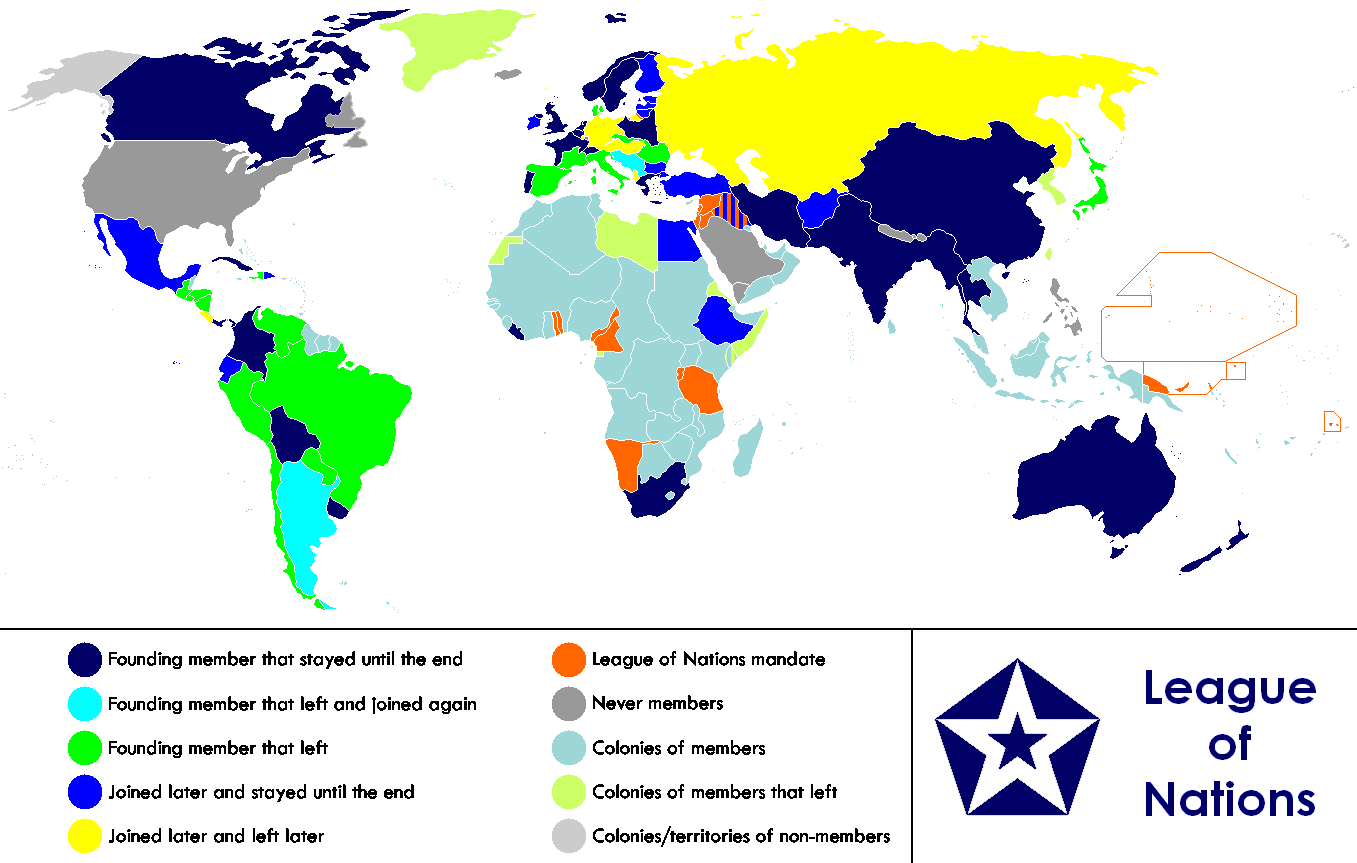
The League of Nations, abbreviated as LN or LoN, (FrenchSociété des Nations [sɔsjete de nɑsjɔ̃], abbreviated as “SDN” or “SdN” and meaning “Society of Nations”) was the first worldwide intergovernmental organisation whose principal mission was to maintain world peace.[1] It was founded on 10 January 1920 following the Paris Peace Conference that ended the First World War; in 1919 U.S. president Woodrow Wilson won the Nobel Peace Prize for his role as the leading architect of the League.

The organisation’s primary goals, as stated in its Covenant, included preventing wars through collective security and disarmament and settling international disputes through negotiation and arbitration.[2] Other issues in this and related treaties included labour conditions, just treatment of native inhabitants, human and drug trafficking, the arms trade, global health, prisoners of war, and protection of minorities in Europe.[3] The Covenant of the League of Nations was signed on 28 June 1919 as Part I of the Treaty of Versailles, and it became effective together with the rest of the Treaty on 10 January 1920. The first meeting of the Council of the League took place on 16 January 1920, and the first meeting of Assembly of the League took place on 15 November 1920.

The diplomatic philosophy behind the League represented a fundamental shift from the preceding hundred years. The League lacked its own armed force and depended on the victorious First World War Allies (France, the United Kingdom, Italy and Japan were the permanent members of the Executive Council) to enforce its resolutions, keep to its economic sanctions, or provide an army when needed. The Great Powers were often reluctant to do so. Sanctions could hurt League members, so they were reluctant to comply with them. During the Second Italo-Abyssinian War, when the League accused Italian soldiers of targeting Red Cross medical tents, Benito Mussolini responded that “the League is very well when sparrows shout, but no good at all when eagles fall out.”[4]

https://en.wikipedia.org/wiki/League_of_Nations

Anachronous world map showing member states of the League during its 26-year history.

will (n.)

Old English willwilla “mind, determination, purpose; desire, wish, request; joy, delight,” from Proto-Germanic *wiljon- (source also of Old Saxon willio, Old Norse vili, Old Frisian willa, Dutch wil, Old High German willio, German Wille, Gothic wilja “will”), related to *willan “to wish” (see will (v.1)). The meaning “written document expressing a person’s wishes about disposition of property after death” is first recorded late 14c.

will (v.1)

Old English *willanwyllan “to wish, desire; be willing; be used to; be about to” (past tense wolde), from Proto-Germanic *willjan (source also of Old Saxon willian, Old Norse vilja, Old Frisian willa, Dutch willen, Old High German wellan, German wollen, Gothic wiljan “to will, wish, desire,” Gothic waljan “to choose”).

The Germanic words are from PIE root *wel- (2) “to wish, will” (source also of Sanskrit vrnoti “chooses, prefers,” varyah “to be chosen, eligible, excellent,” varanam “choosing;” Avestan verenav- “to wish, will, choose;” Greek elpis “hope;” Latin volovelle “to wish, will, desire;” Old Church Slavonic voljovoliti “to will,” veljoveleti “to command;” Lithuanian velyti “to wish, favor,” pa-velmi “I will,” viliuos “I hope;” Welsh gwell “better”).

Compare also Old English wel “well,” literally “according to one’s wish;” wela “well-being, riches.” The use as a future auxiliary was already developing in Old English. The implication of intention or volition distinguishes it from shall, which expresses or implies obligation or necessity. Contracted forms, especially after pronouns, began to appear 16c., as in sheele for “she will.” In early use often -ile to preserve pronunciation. The form with an apostrophe (‘ll) is from 17c.

World Intellectual Property Organization

The World Intellectual Property Organization (WIPOFrenchOrganisation mondiale de la propriété intellectuelle (OMPI)) is one of the 15 specialized agencies[1][2][notes 1] of the United Nations (UN). WIPO was created in 1967 “to encourage creative activity, to promote the protection of intellectual property throughout the world”.[5]

WIPO currently has 193 member states,[6] administers 26 international treaties,[7] and is headquartered in GenevaSwitzerland. The current Director-General of WIPO is Francis Gurry, who took office on 1 October 2008.[8] 190 of the UN member states as well as the Cook IslandsHoly See and Niue are members of WIPO. Non-members are the states of Federated States of MicronesiaPalau and South SudanPalestine has permanent observer status.[9

https://www.wipo.int/portal/en/index.html